Audio Cue Locator
A tool for locating known audio cues inside larger audio or video files.
ACL takes source media and one or more reference cues, locates their temporal occurrences, and presents per-cue results with positions, similarity scores, audio preview, and JSON export.
What the project does
Audio Cue Locator (ACL) locates known audio segments inside larger audio or video files. The user provides source media and one or more WAV reference cues; the backend prepares the audio into a canonical representation, searches for occurrences of each reference, and returns timeline positions with method-specific similarity scores. The same application core serves both the WebUI and REST API.
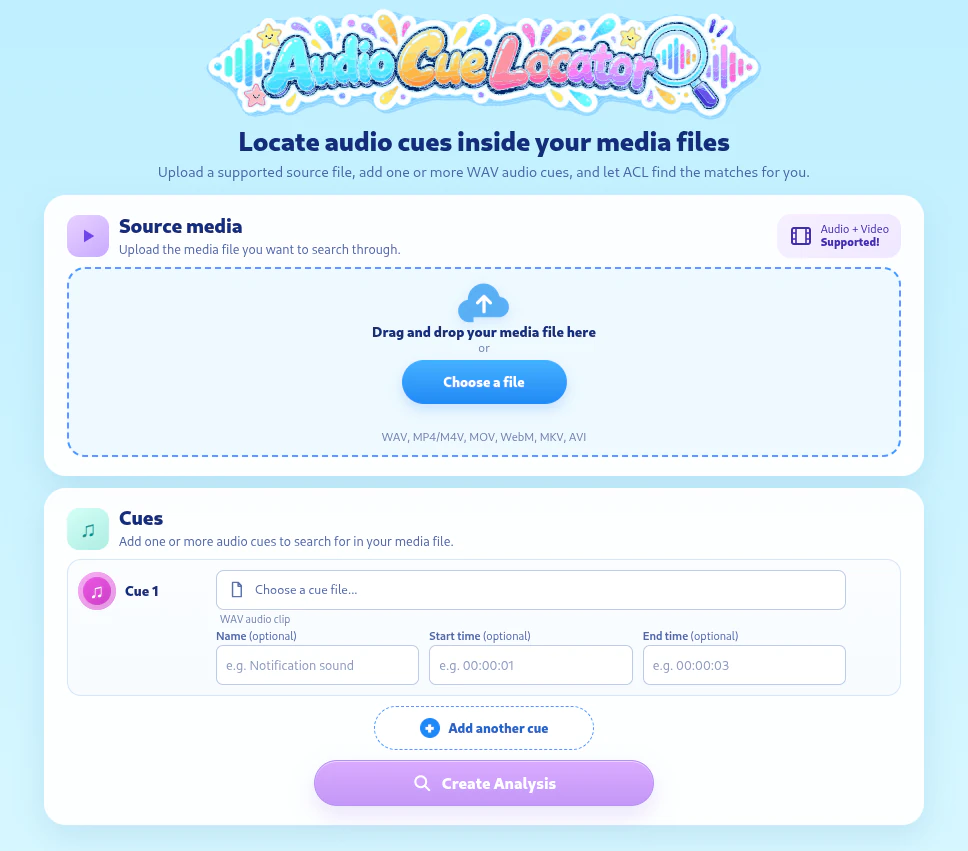
From setup to results
The WebUI keeps the complete workflow on a single screen. Each cue can have a name and optional start and end bounds that restrict the region searched in the source media without trimming the cue itself.
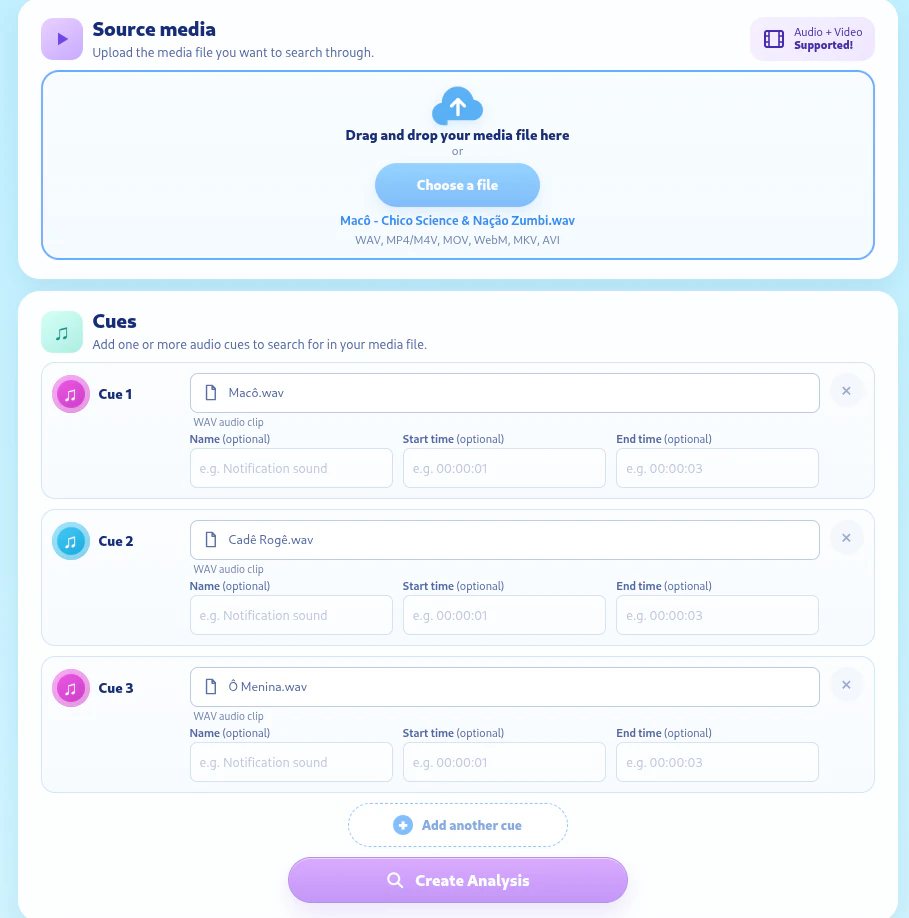
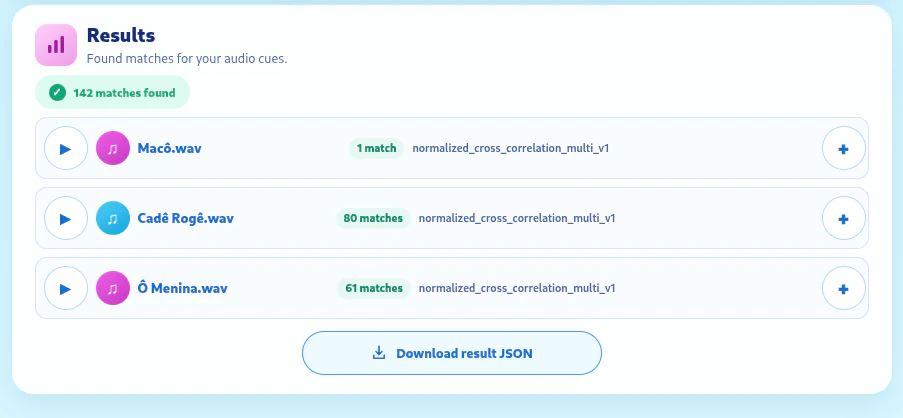
Once the Analysis is created, results are grouped by cue, showing occurrence counts, the effective matching method, and an option to export the structured result as JSON.
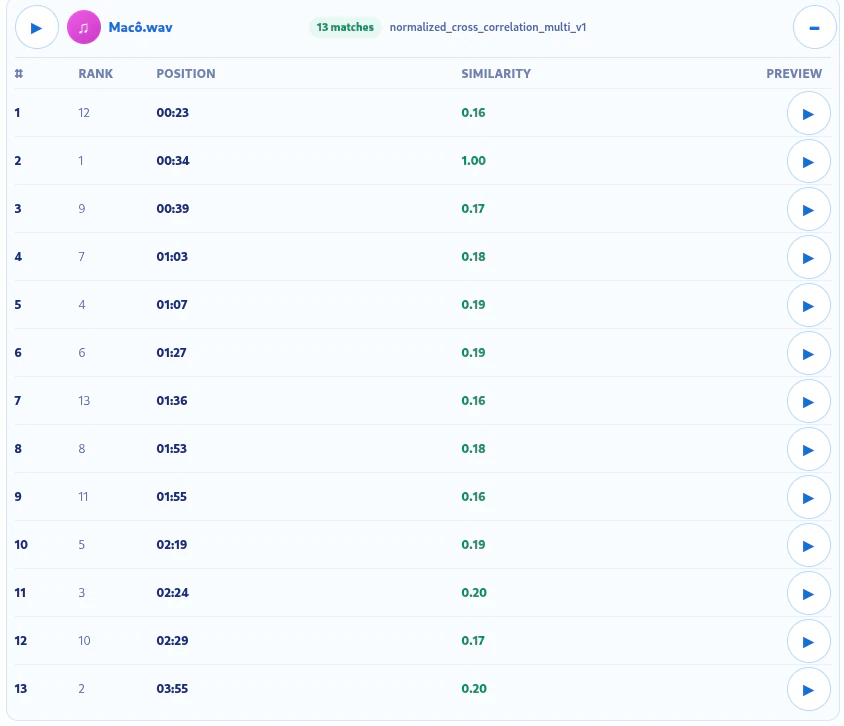
Inspecting occurrences
Each cue group can be expanded to review occurrences in chronological order. The interface separates index, similarity rank, temporal position, and score, while also allowing the user to audition the cue and the corresponding segment from the source media.
The score is specific to the matching method. It is not a percentage or statistical confidence, and the effective threshold is preserved as part of the Analysis configuration.
Current scope
The current implementation provides the core end-to-end workflow for locating known audio cues in larger audio or video sources, including media canonicalization, configurable matching, occurrence inspection, playback, and structured result export. This implementation represents the completed baseline defined for the project.
Why this project matters
Beyond acoustic matching, ACL explores how to turn signal processing into a traceable product: effective configuration preserved per Analysis, versioned results, local persistence, and both an API and a WebUI built on the same application core.
The implemented baseline represents the completed scope of this project, while future enhancements may be explored independently.